What’s Changing Legally for Designers Now

Designers today are increasingly working with artificial intelligence (AI). Images are created in seconds, product ideas can be visualised with just a few prompts, and initial designs can be developed faster than ever before. Yet the more seamlessly these new tools become integrated into the design process, the more pressing the legal questions become:
- Who owns a generated design?
- When must the use of AI be disclosed?
- And what responsibility do companies bear when technology becomes a creative tool?
These were the questions addressed at the German Design Council Foundation’s Members Talk. In this online discussion series, lawyers Dr Christoph Matras and Sarah Rost from the commercial law firm FPS highlighted the biggest legal pitfalls and explained why companies should not wait until the finished product is ready before addressing compliance issues.
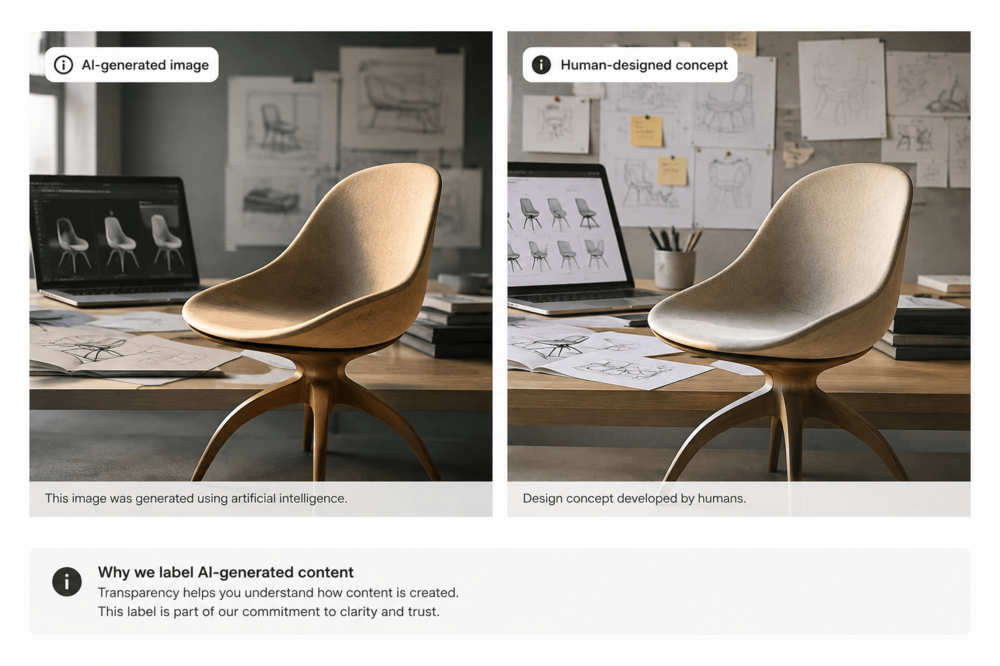
Even the choice of AI tool is more than just a technical decision. Whether it’s ChatGPT, Claude, Midjourney or other applications: it is important to consider not only which system delivers the best results, but also what terms of use apply and whether the generated output may be used commercially. Added to this are the requirements of the EU AI Act, which is gradually making transparency and documentation obligations binding. “We need to factor in the commercialisation of AI-generated designs right from the start of the creative process – and not just when the final product is ready,” explained Sarah Rost. The legal review begins much earlier than many companies realise.
It’s the Human Touch That Makes the Difference
The question of copyright remains just as important. “Works generated purely by AI are not eligible for protection. It always comes down to the original creative contribution,” explains Christoph Matras. The decisive factor, therefore, is the creative contribution made by a human being. Anyone who selects variants, alters proportions or creatively refines a design may, under certain circumstances, still be able to establish protection.
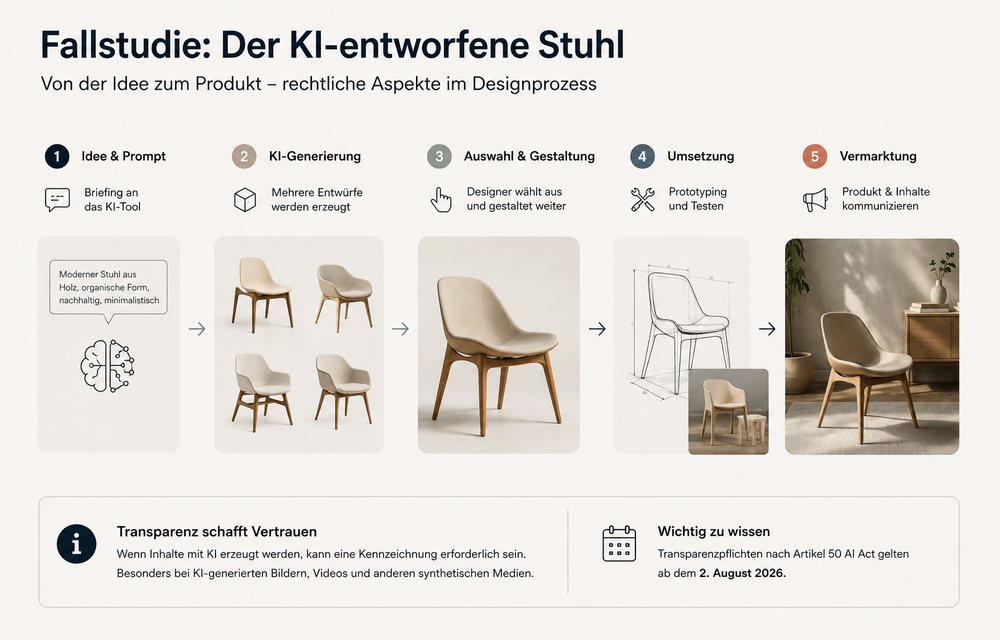
There is also frequent uncertainty regarding the future labelling requirement. A product designed with the aid of AI does not, as a matter of principle, have to be labelled ‘AI-designed’. In the case of AI-generated, synthetic media that appear realistic, such as images or videos, as well as content intended to influence opinion, Article 50 of the AI Act – the transparency requirement – applies. Such content must therefore be immediately visible and clearly labelled as AI content from 2 August 2026.
Article 53 addresses a different issue: it does not concern the labelling of individual pieces of content, but rather the providers of generative AI models. Among other things, they must disclose information on training data and copyright. For businesses, this information is particularly relevant when selecting an AI tool and conducting risk analysis.
Legal Certainty Requires Clear Processes
With the increasing prevalence of generative AI, contracts and internal processes are also becoming more important: companies should document which tools they have used, record the human creative input in a traceable manner, and set out responsibilities in contracts. After all, it is not the AI that remains liable in the end, but the individual or the company that publishes the output.
Another aspect will become increasingly important in future: AI competence. The AI Act stipulates an obligation to ensure sufficient AI competence. Companies must ensure that their staff who use AI systems also possess the necessary knowledge. This involves not only the confident use of prompts, but also an understanding of the legal, technical and creative limitations of the systems.
The key message of the Members’ Talk was therefore: generative AI opens up new possibilities, but it replaces neither creative decision-making nor legal responsibility. Anyone wishing to harness the potential of the technology should therefore not view it in isolation, but as part of a professionally organised design process – from tool selection to marketing.
What Is the EU AI Act?
The EU AI Act is the first comprehensive regulation governing artificial intelligence. It classifies AI applications into three risk levels: systems posing an unacceptable risk, such as state-run social scoring schemes, are prohibited. Strict requirements apply to high-risk applications, such as programmes for the automated assessment of job applications. All other AI applications remain largely unregulated. Generative AI is not considered a high-risk system, but is subject to labelling and transparency requirements.
Further links:
FPS’s ‘AI Check’ provides a concise overview of the key provisions and requirements of the AI Regulation: fps-law.de/en/FPS-AI-Check
Official overview page of the European Parliament: www.europarl.europa.eu/topics/en/article/20230601STO93804/eu-ai-act-first-regulation-on-artificial-intelligence
Official website of the European Commission. The Code of Practice helps the industry to comply with the legal obligations of the AI Act regarding safety, transparency and copyright for general-purpose AI models: digital-strategy.ec.europa.eu/en/policies/contents-code-gpai