
Robotic Worlds: Staged Future
Professor Gordon Cheng, Head of the Chair of Cognitive Systems at the Technical University of Munich, is one of Germany's leading robotics researchers. His focus is on humanoid cognitive systems, and he is co-curator of the exhibition ‘Robotic Worlds,’ which opened on 28 November at the Neue Sammlung. Among other things, Cheng and his team developed e-Skin, a flat sensor system that enables robots to perceive their surroundings in a differentiated way. More on that later.
'I'm enjoying this,' says Cheng, referring to the current wave of announcements about new humanoid robots. ‘I've been working on humanoids for 25 years and know how difficult they are to develop – because they are primarily a cognitive problem.’ What he means is the ability of robots to recognise their environment, respond to it and interact with humans clearly, quickly and safely. E-skin is considered a key to solving this problem. According to Chang, the current surge in development is also based on the significantly improved availability of components today: ‘Accessibility has changed radically.’ And what about the social acceptance of humanoid machines? ‘The uncanny valley will disappear,’ Cheng is convinced. Dealing with anthropomorphic robots will become commonplace, interaction will become a matter of course. When asked about his favourite exhibit in the exhibition, he answers without hesitation: ‘The HRP-2 over there.’ The humanoid research robot was conceived in Japan around 2002 and designed by manga artist Yutaka Izubuchi. ‘There are only a few “Spacemen” in existence. Thanks to my contacts, I was able to secure one from France for the exhibition.’

From the white cube to production aesthetics
‘Robotic Worlds represents a new approach to exhibition design,’ emphasises collection director Angelika Nollert. Fewer icons, a departure from strictly chronological narratives and, instead, the highlighting of cross-connections and more future-oriented themes – this is the programmatic reorientation. Nollert has announced exhibitions on sustainability and inclusive design for 2026, which are to be reimagined and restaged. The spatial design of Robotic Worlds is already striking: the exhibits are no longer displayed in a neutral white cube setting, but on industrial conveyor belts or in cages, as seen in automated manufacturing environments. This is an obvious but ultimately insufficient analogy by the Munich-based design firm OHA. On the one hand, it reproduces the outdated image that robotics is primarily an industrial phenomenon. On the other hand, the yellow paintwork of the intricate constructions dominates the already limited space so strongly that individual exhibits lose their presence.


An exhibition with gaps
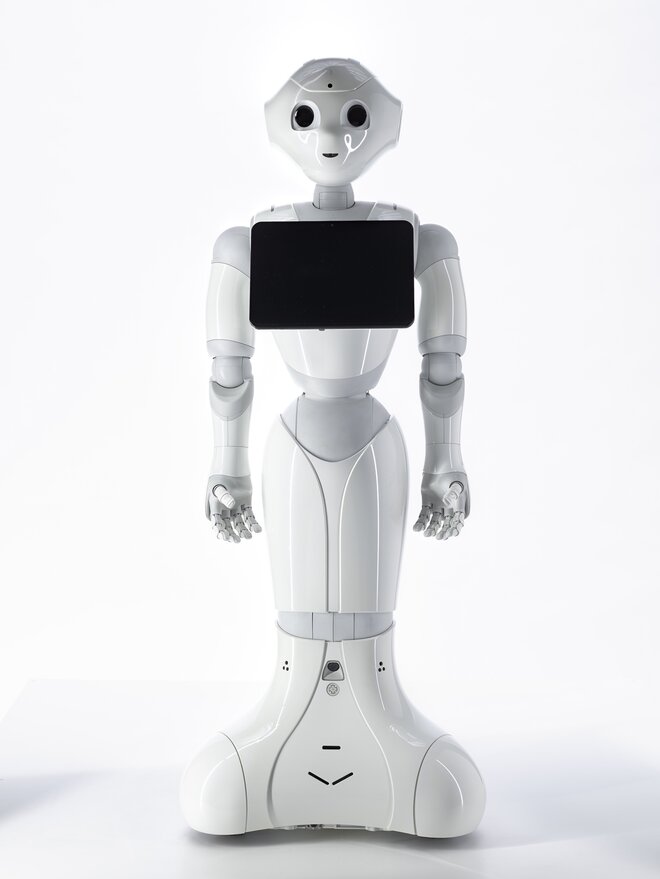
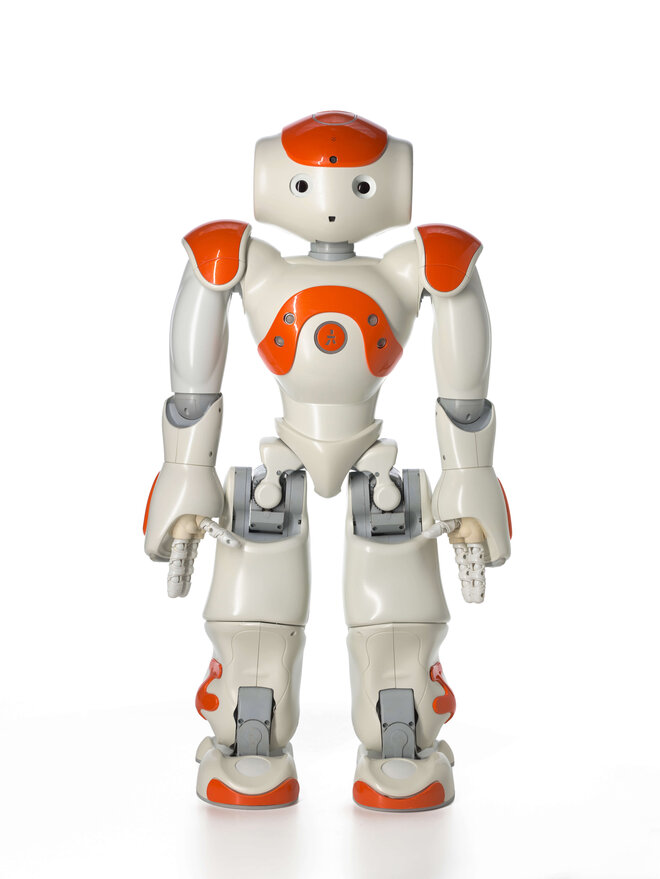
The exhibition curated by Caroline Fuchs is not comparable to ‘Hello, Robot’, the comprehensive show organised by the MAK Vienna and the Vitra Design Museum in 2017. Robotic Worlds brings together significantly fewer exhibits and hardly integrates them into any overarching context. Key developments are represented – Sony's robot dog Aibo, the social robot Pepper, the HRP-2 and a cobot with e-skin. But the objects remain largely isolated, even though they are placed next to each other on conveyor belts. There is no coherent narrative, no bigger picture of robotics. The cuddly socialbot Lovot sits on a chair designed especially for him. This would have been an opportunity to explore the important question raised by Caroline Fuchs: whether robots will need their own ‘product zoo’ of accessories, furniture and environments in the future. Despite impressive exhibits such as the Airarm Grippers, developed in 2012 by a team led by Axel Thallemer at Festo and clearly biomorphic in design, Robotic Worlds remains strangely distant. What is completely missing is the classic industrial robot – the core of industrial automation. Professional cobots are also nowhere to be found. This is a pity, but perhaps also due to the limited space available for the exhibition. One final point of criticism at this point: the exhibits remain immobile behind Plexiglas. This means that interaction is just as impossible as experiencing the kinematics and dynamic movements. According to Caroline Fuchs, permanently active robots would require close supervision by specialists, which is simply not feasible with the available on-board resources. Nevertheless, it would have been desirable – at least for individual exhibits.
The key to new robotics
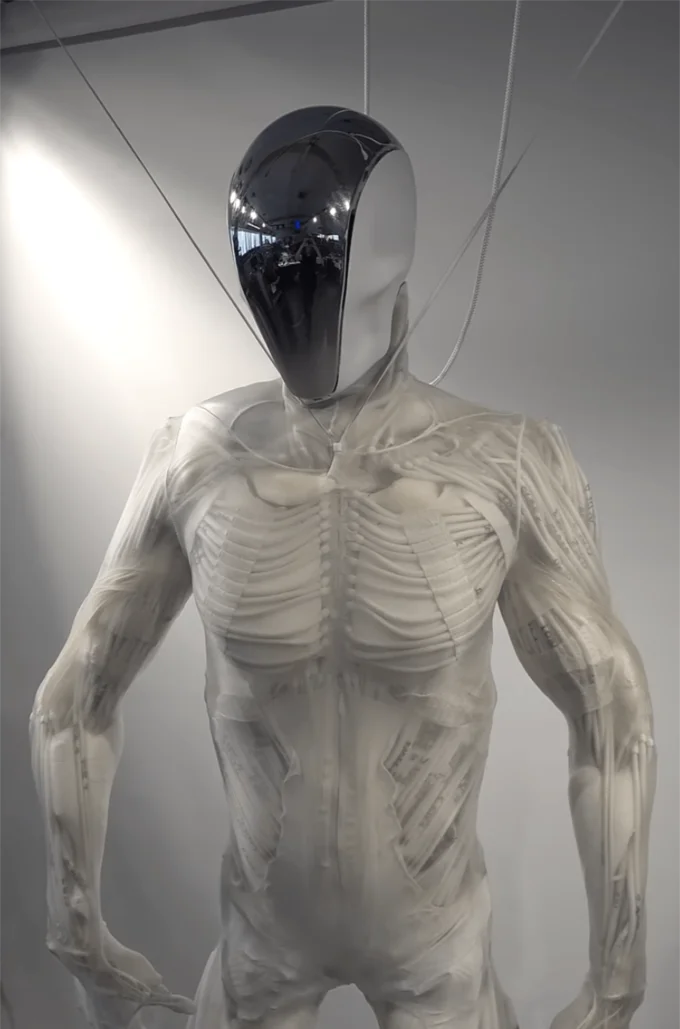
Back to e-Skin, one of the most exciting exhibits: developed in 2012, this cognitive robot skin consists of hexagonal cells, each containing sensors for pressure, acceleration, distance and temperature, which can detect when people are approaching, for example. The result is robots with a kind of body awareness and learning interaction. The exhibition shows how this skin is constructed using a small, multi-axis cobot with the multi-jointed Allegro gripper hand from Korea. Both the hand and the robot arm have been upgraded with e-Skin – this means greater safety in interaction and, at the same time, an enormously sensitive hand. Cheng then equipped the small humanoid H-1 with a total of 13,000 sensors, with 1,260 cells spread across the robot's entire body, including the soles of its feet. This enables it to react to unevenness in the ground and interact sensitively with humans. Unfortunately, it did not make it from the laboratories to the exhibition because it is still needed for research.
Reality and fantasy
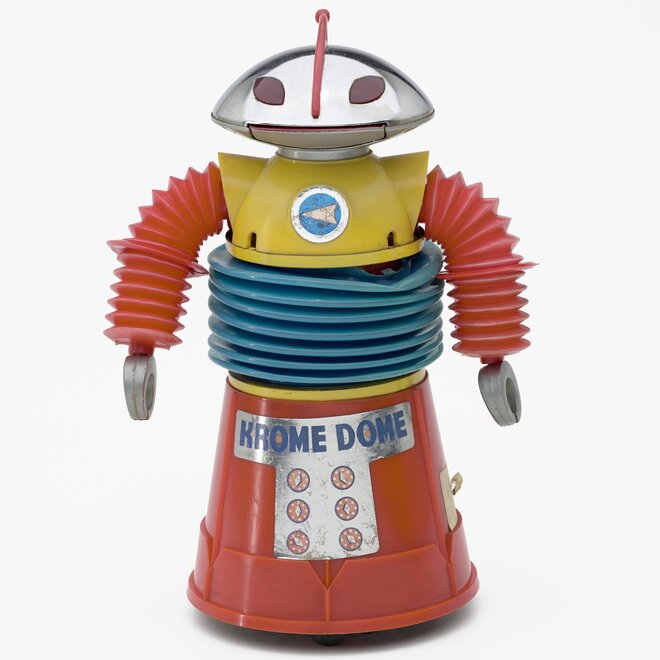
‘Robotic Worlds’ does not focus solely on hardware, but also accompanies it with various posters and placards. Robots play leading and supporting roles there, not only in the context of science fiction. While these make you smile, the third exhibition level provokes genuine laughter. In 2022, the Neue Sammlung acquired an extensive private collection of numerous toy robots from the 1960s to the 1980s, which are now on display for the first time. These include tin rockets from Hungary as well as saucer-like flying objects and angular machine creatures on legs with a wind-up function. As a boomer, it's a special treat to encounter your actual or imagined childhood playmates again, who, from today's perspective, were rather naive. In short: a detour to the Neue Sammlung with ‘Robotic Worlds’ is well worth it – but you should allow plenty of time, because its compactness makes it ideal for taking a close look. It doesn't have to be tomorrow, because the exhibition runs until 28 November 2027.