Trinity of Design, Brand and Innovation
The idea of innovations is often associated with lucky coincidences like the discovery of X-rays, Penicillin or Post-its. This might create the false expectation that any invention will become an innovation, that one has just to be lucky to get hit by destiny.
But we all know that this is not the case. An invention is merely the pure act of creating something new. Only when an invention is transformed into accessible utility in form of a product or service, then we can talk about an innovation. And this transformation is not only likely to fail, it will indeed fail in most cases. Therefore, there is more to being innovative than just being inventive. And chance may only help the latter.
The good news is: once an innovation becomes successful, its adoption process is exponential and becomes faster and faster. While the automobile needed 45 years to be adopted by 60% of the market, it only took the smartphone five years to accomplish the same. Think about Airbnb and Uber – innovative business models – which took only a few years to disrupt whole industries. This poses an important question: If innovations are not random and very appealing business-wise, how are ideas transformed into innovations, then?
Design, Brand and Innovation
It is, in fact, a well-researched multi-complex interrelation of many factors, although there is no single formula for success. But for me, two drivers stick out: design and brand. Together with innovations they are the three focus pillars of our work at the German Design Council.
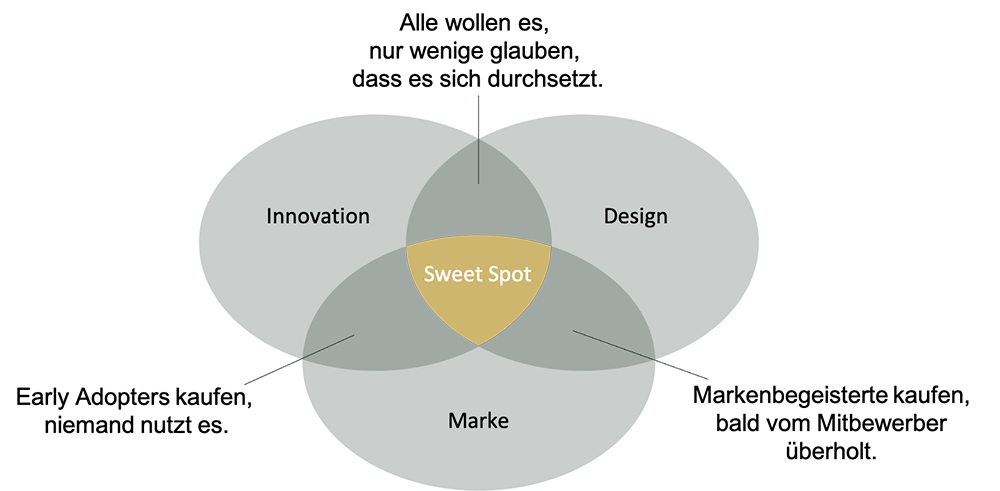
I firmly recommend aiming for this trinity, because all three combined form the sweet spot for the most promising starting point for every product or service to conquer a market. Certainly, products do survive beyond the sweet spot, but obviously it comes with certain disadvantages:
The crossover of innovation and design seems very attractive, but it is worthless without a strong brand to back up the promoted product features. Having a great design and a strong brand will attract brand enthusiasts, but even those will only follow until the features are outdated. And finally, a well-branded innovation is likely to fail without design, since nobody enjoys using it.
And there are real-life examples that justify this trinity. Nike, as a strong brand in the sports market, launched the Nike+ FuelBand in 2012 – one of the very first of its kind. But Nike did not have the brand power to convince its customers of its technological competence.
Two years after the launch, Nike stopped the experiment and today this market is owned by tech-companies.
User-Friendliness is Key
I strongly recommend always putting the user in the centre of the innovation process. Design thinking and open innovation are two methods that can help avoid such mistakes. Both include the user into the development circle of products and services, which will eventually also result in a user-friendly design. And user-friendliness can boost an innovation tremendously!
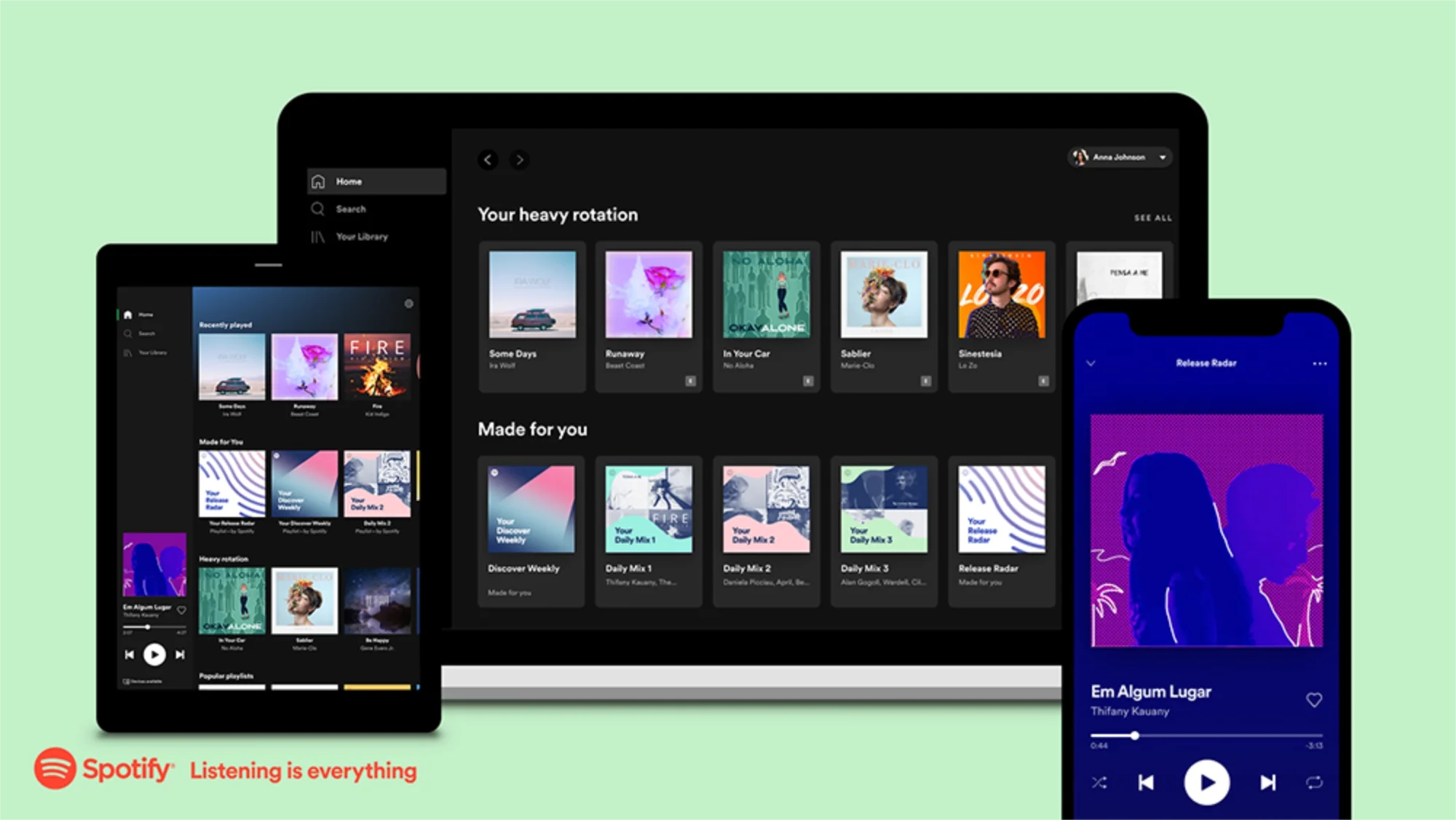
Well-tested user design, such as that of Spotify, does have a real impact on the revenue-side. Spotify is more successful than Amazon Music, despite Amazon having virtually unlimited resources. However, among other reasons, Spotify’s usability is much higher than Amazon’s, as measured by the Net-Promoter-Score for both apps.
Another up-and-coming design is the translation software DeepL by a Cologne start-up of the same name. With the help of algorithms and artificial intelligence, the translation device has become a serious competitor to Google translate, although the difference in financial power is comparable to that of Spotify and Amazon. In a scientific blind test involving translation experts, DeepL outperformed not only Google Translate, but Microsoft Translator and Facebook’s translator as well.
Hitting the Sweet Spot
So, given that we know that design and brand have a great impact on a product’s success, what happens if all three aspects – innovation, design and brand – come together? The result is a revolutionary success like that of Nintendo in 2006, when they launched the Nintendo Wii. Innovative new gameplay with specially designed controllers and games that put the player in the centre of the experience. It was the first time for a mainstream gaming device that the players’ movements were transferred directly into the game. Additionally, it was launched by the most famous gaming developer of the world: Nintendo. The trinity of innovation, design and brand at its best. The market success is history.
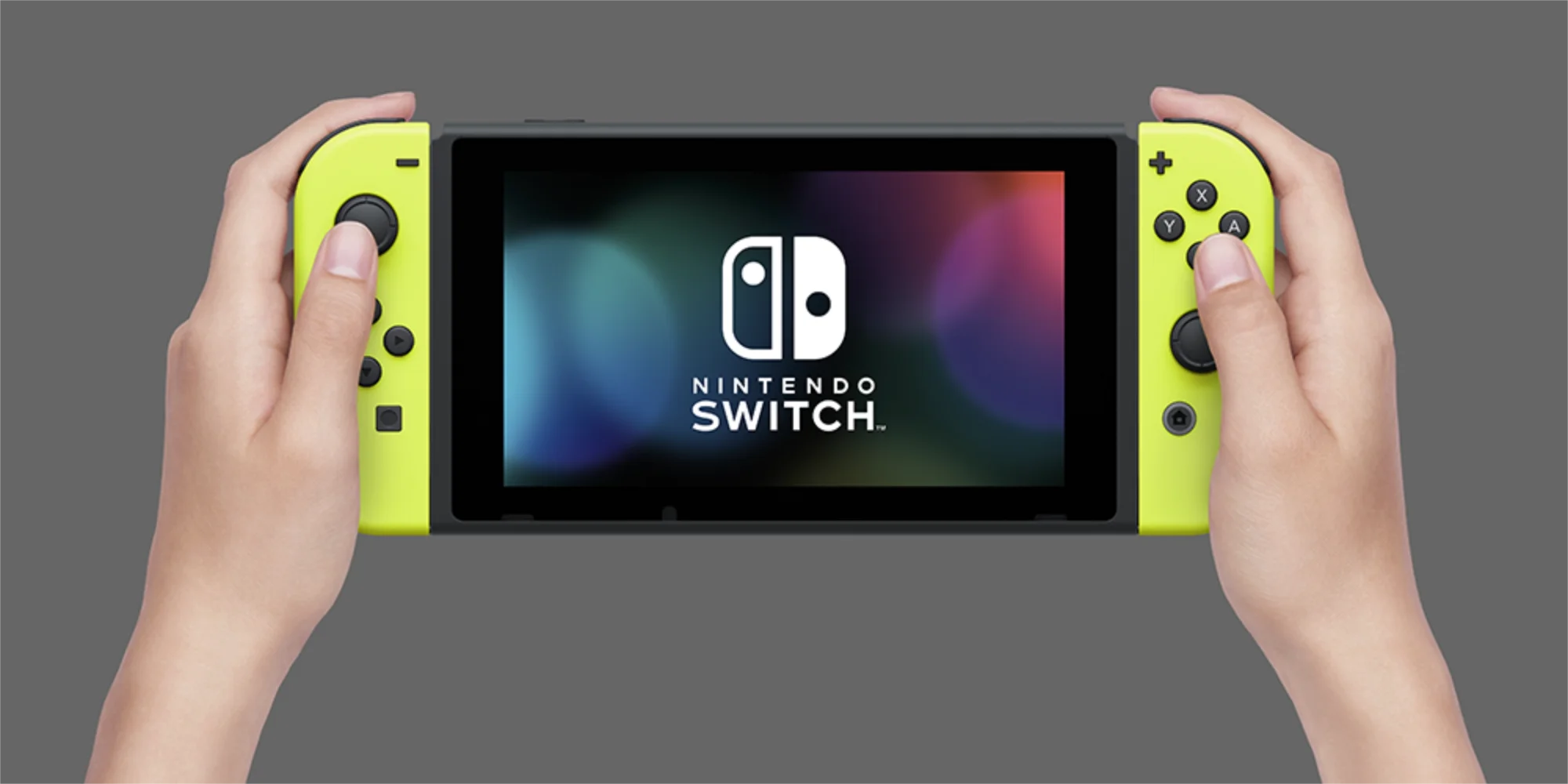
This achievement is by no means a one-hit-wonder. Nintendo re-demonstrated this success nearly ten years later. The Nintendo Switch scored another strike as the first handheld device that can also be used as either a classical console in conjunction with a TV, or a hand-held one with a two-player option. Its success story still follows the same path as the Nintendo Wii.
Comparable success is achieved by more practical forms of software, as well. SAP’s top seller, the High-Performance Analytic Appliance “S/4Hana” is an in-memory version of the earlier Business Suite ERP platform. With its ease of use and ability to handle very large amounts of data, HANA is among the leading tools used by companies of all industries. With their sophisticated and easy-to-use business applications, SAP has become a global provider of enterprise resource planning software and ranks among the world’s largest software companies.
Another product that hit the sweet spot in the true sense of the word are the Gummy Bears. Since their conception by German sweets company Haribo nearly a century ago, the colourful bears enjoy strong and ongoing popularity. Although gelatin-based shaped candy had been invented earlier, it was the unison with their charming design and strong branding that made the little bears a global – and since then often imitated – success. To ensure their signature product stands the challenges of changing market-demands, Haribo keeps further developing their design and, for instance, began using natural colouring derived from fruit and vegetable juices in 2007 to meet growing demands for more natural ingredients. The success is evident: today, Gummy Bears are a synonym for shaped candy.
And while these are perfect examples of how a strong brand can assist an innovative product, the opposite is definitely true as well. Being innovative also fuels the value of a brand, as the most innovative brands are also the most valuable. Of course, this is influenced by many different aspects besides innovativeness, but it is hardly a coincidence.
The author: Lutz Dietzold
Lutz Dietzold (*1966) has been CEO of the German Design Council since 2002. Prior to that, he worked as a design communication freelancer and was managing director of Designzentrum Hessen (Hesse Design Centre), where he was responsible for the strategic reorientation of design promotion.
Grounded on his studies of art history, classical archaeology and German language and literature in Frankfurt Lutz Dietzold has gathered extensive experience of design, branding and innovation. He also has a special interest in promoting design and up-and-coming designers. In 2011, he became a member of the advisory council of the Mia Seeger Stiftung (Mia Seeger Foundation) and a member of the Stiftung Deutsches Design Museum (German Design Museum Foundation), subsequently taking on the role of chairman in 2020. He was appointed to the Dieselkuratorium's Board of Trustees in the same year and is dedicated to strengthening the pioneering role of commercially successful innovators.
Lutz Dietzold is also working to increase the international orientation of the German Design Council and its global network of leading companies from industry and the business world. This includes setting up a subsidiary in China.
Lutz Dietzold publishes articles on a regular basis and gives national and international lectures on a variety of topics. He is also a member of numerous committees and juries and sits on the project advisory board of the German Federal Ecodesign Award of the Bundesumweltministerium (German Federal Ministry for the Environment, Nature Conservation and Nuclear Safety).