A Testing Ground for an Early Design Economy
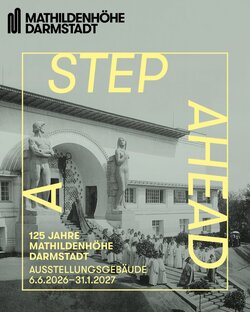
125 years after the first exhibition of the Artists’ Colony, the Institut Mathildenhöhe Darmstadt is once again turning its gaze towards the future. With A Step Ahead – presented as part of World Design Capital 2026 Frankfurt RheinMain – it sets contemporary impulses while reconnecting with its own history as a site of creative innovation. From 7 June 2026 to 31 January 2027, the exhibition explores how design, architecture, and art shape social developments – both then and now. What has become of the progressive 1901 vision of improving everyday life through design?
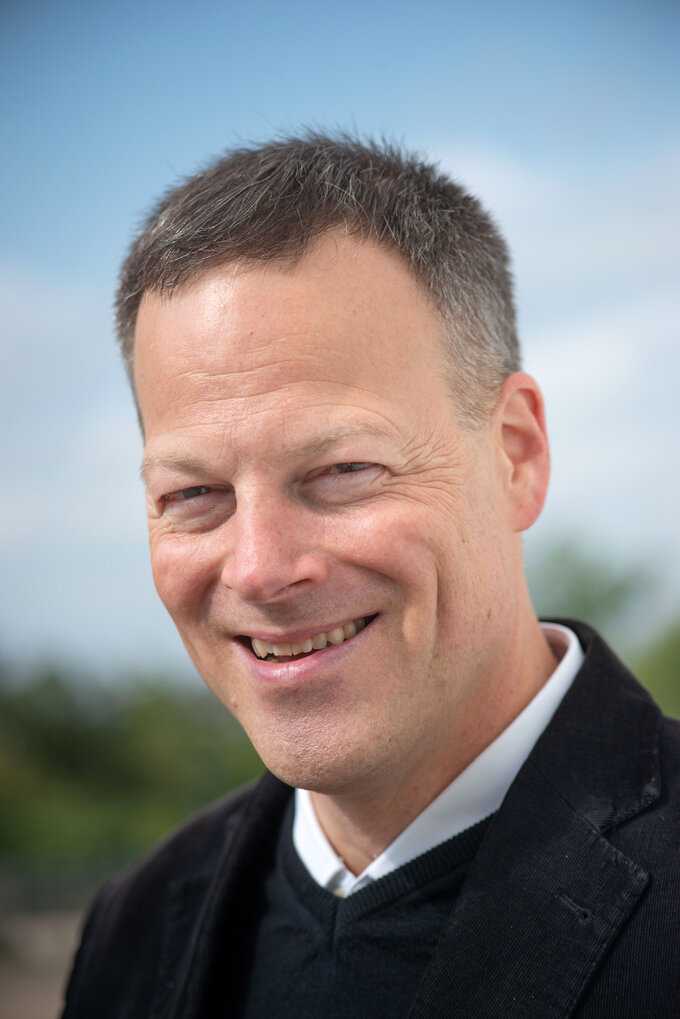
Across four halls, the exhibitions of 1901, 1904, 1908, and 1914 are revisited in order to create resonant spaces for central themes such as visions of the world, community and individuality, identity and society, as well as introspection and departure. Historical design approaches of the Artists’ Colony are linked with contemporary questions: new modes of production, innovative materials, participatory processes, and the use of artificial intelligence open up perspectives on future ways of living. Curated by Dr Philipp Gutbrod, Director of the Institut Mathildenhöhe, the exhibition also ventures an experiment: using AI technologies, the first exhibition of 1901 and the architectural exhibition of 1914 are to be reconstructed as 3D visualisations.
An Experimental Laboratory of Modernism
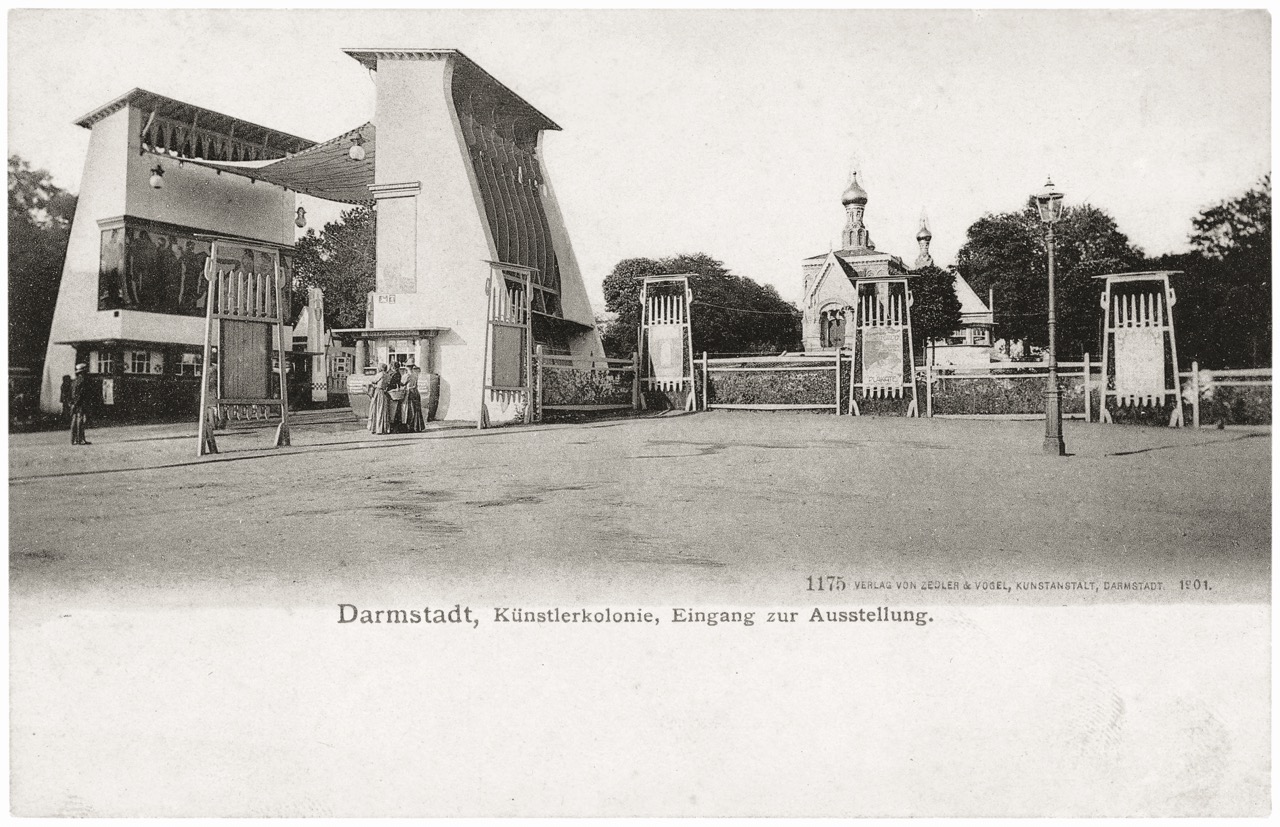
The Mathildenhöhe’s reputation today as a place of creative innovation has its roots around 1900. What emerged there was nothing less than a built experimental laboratory of early modernism – a powerful aesthetic and social experiment. Although the focus shifted between 1901 and 1914, the energies unleashed by Art Nouveau and the reform movement generated an artistic and economic momentum that continued until the outbreak of the First World War abruptly brought the Artists’ Colony to an end.
Opposing an industrial society driven by division of labour and fragmentation, the colony proposed a holistic, aesthetically effective, and durable programme of innovation-friendly collaboration between architecture, interior design, and landscape and urban planning, alongside painting, sculpture, theatre, and dance. It is no coincidence that Walter Gropius and the Bauhaus later built upon the ideas realised in Darmstadt under changed conditions. In 2021, the international significance of the Mathildenhöhe as a place of artistic innovation was confirmed through its designation as a UNESCO World Heritage Site.
The New Beginning under Ernst Ludwig
Without the art-loving Grand Duke Ernst Ludwig, the elevated site – used for centuries as a vineyard due to its location – would likely have remained what it had been since around 1800: a public park. In 1833, following a marriage, it had passed into the possession of Hereditary Grand Duke Ludwig III and his wife Mathilde, after whom it was later named.
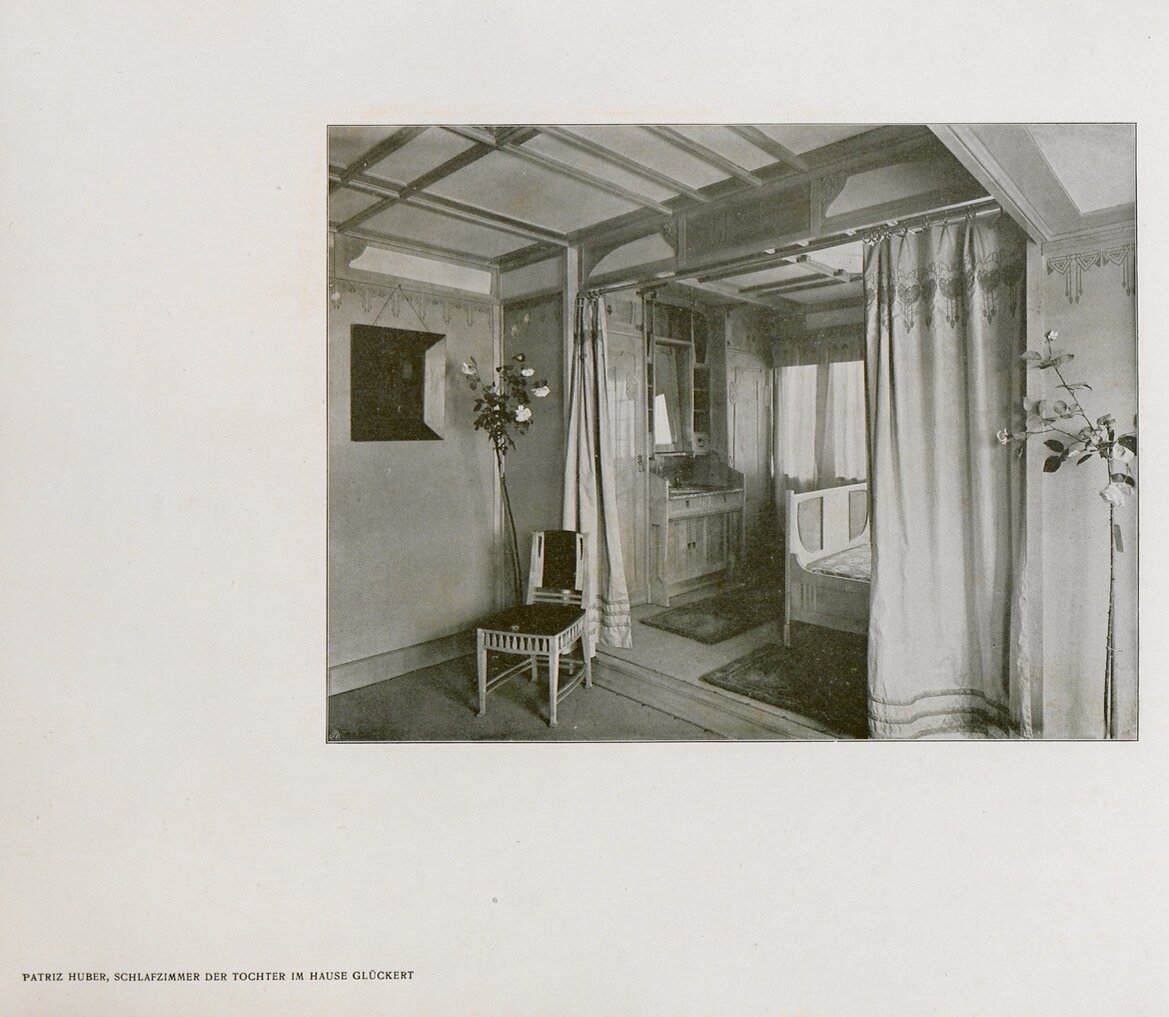
Grand Duke Ernst Ludwig – son of Ludwig IV and grandson of Queen Victoria – had become fascinated by the Arts and Crafts movement during visits to Britain. This movement had emerged in opposition to the anonymous production of industrial mass goods. Open to innovation of every kind, he had, in 1897 – uniquely within German court culture – commissioned a reception room and dining room in his new Darmstadt palace in the progressive style. The Grand Duke’s ambitions, however, extended much further. He aimed to initiate an aesthetically grounded reform of the applied arts that would also become effective in terms of production methods and economics, permeating every area of everyday life. Ideas on how to achieve this matured through intensive exchanges with publisher and publicist Alexander Koch. In autumn 1898, Koch demonstrated his vision concretely: at a Darmstadt arts and crafts exhibition, he presented fully staged interiors furnished entirely with functional works of applied art.
The Birth of the Artists’ Colony
It should not be forgotten that, since 1880, the city’s water reservoir had occupied the highest point of the hill. In 1899, the Russian Chapel Darmstadt was also inaugurated. It had been commissioned by Nicholas II and designed by court architect Benois using specially transported Russian soil. The Tsar had married Ernst Ludwig’s sister in 1894 and required an Orthodox church for visits to the birthplace of his wife Alexandra.
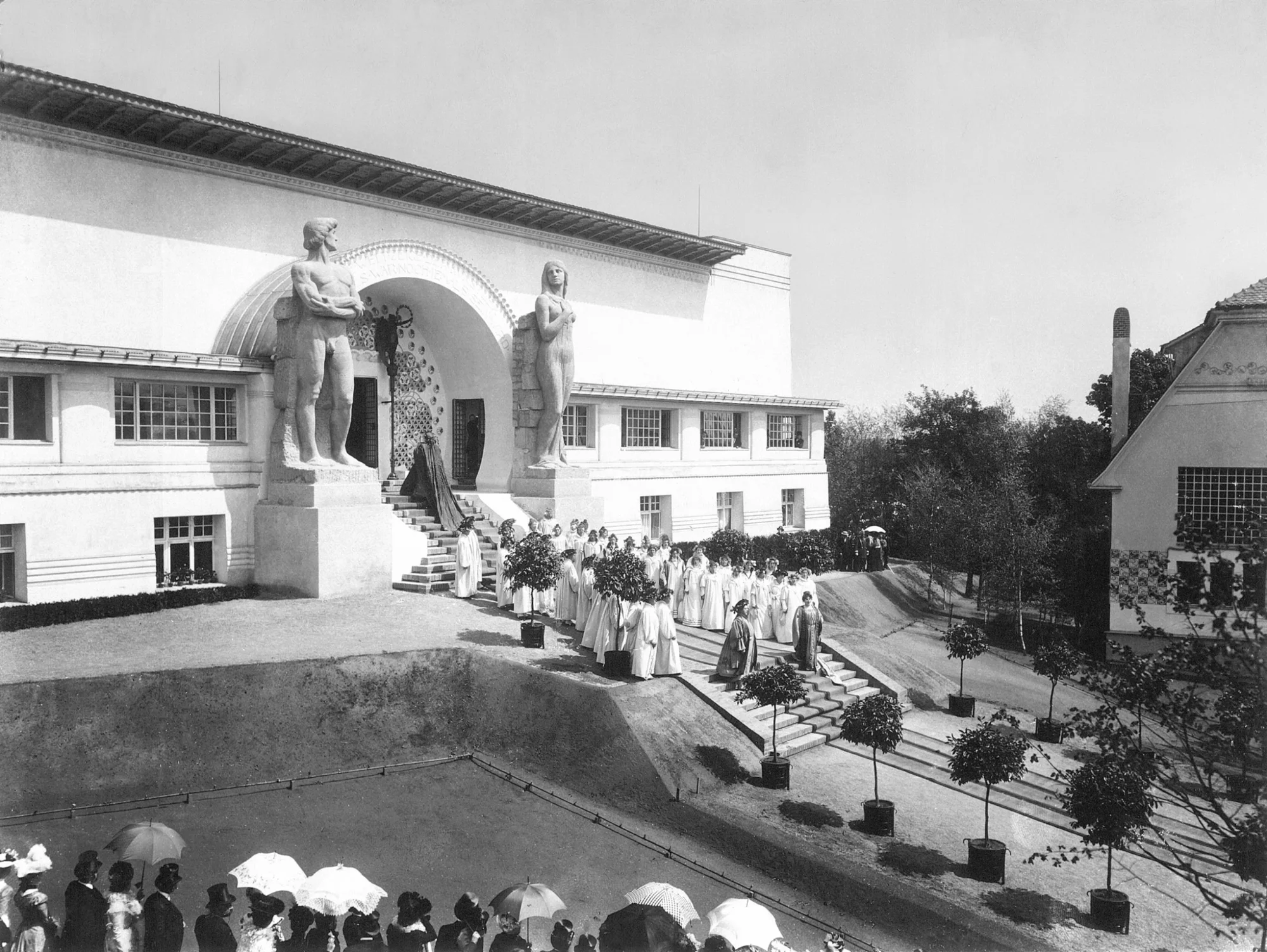
That same year, Grand Duke Ernst Ludwig appointed seven artists – among them Hans Christiansen from Paris, Joseph Maria Olbrich from Vienna, and Peter Behrens from Munich – in order to establish Darmstadt as a centre of arts and crafts reform. On 15 May 1901 at 11 a.m., the first exhibition of the Artists’ Colony opened ceremonially on the Mathildenhöhe under the title A Document of German Art. Accompanied by fanfares, the inauguration featured a ritual play entitled The Sign, conceived by Peter Behrens with music by Willem de Haan and texts by Georg Fuchs. The socio-political vision had already become clear during the laying of the foundation stone for the Ernst Ludwig House:
“Here lies the new, the significant, the convincing quality of this exhibition, which breaks with the frosty fairground character and will present an art that has emerged from life, serves life, and seeks to elevate it.”
Influence Far Beyond Darmstadt
With the creation of the Artists’ Colony and the 1901 exhibition, Ernst Ludwig succeeded in establishing the capital of his Grand Duchy as one of the most important centres of arts and crafts reform around 1900. The exhibition attracted widespread attention, although it ended in financial disaster. By 1903, the first artists had already left the colony. Peter Behrens in particular, who had struggled to assert himself against Olbrich, subsequently founded his own practice in Berlin and became mentor to later protagonists of modern architecture such as Walter Gropius, Ludwig Mies van der Rohe, and Le Corbusier.
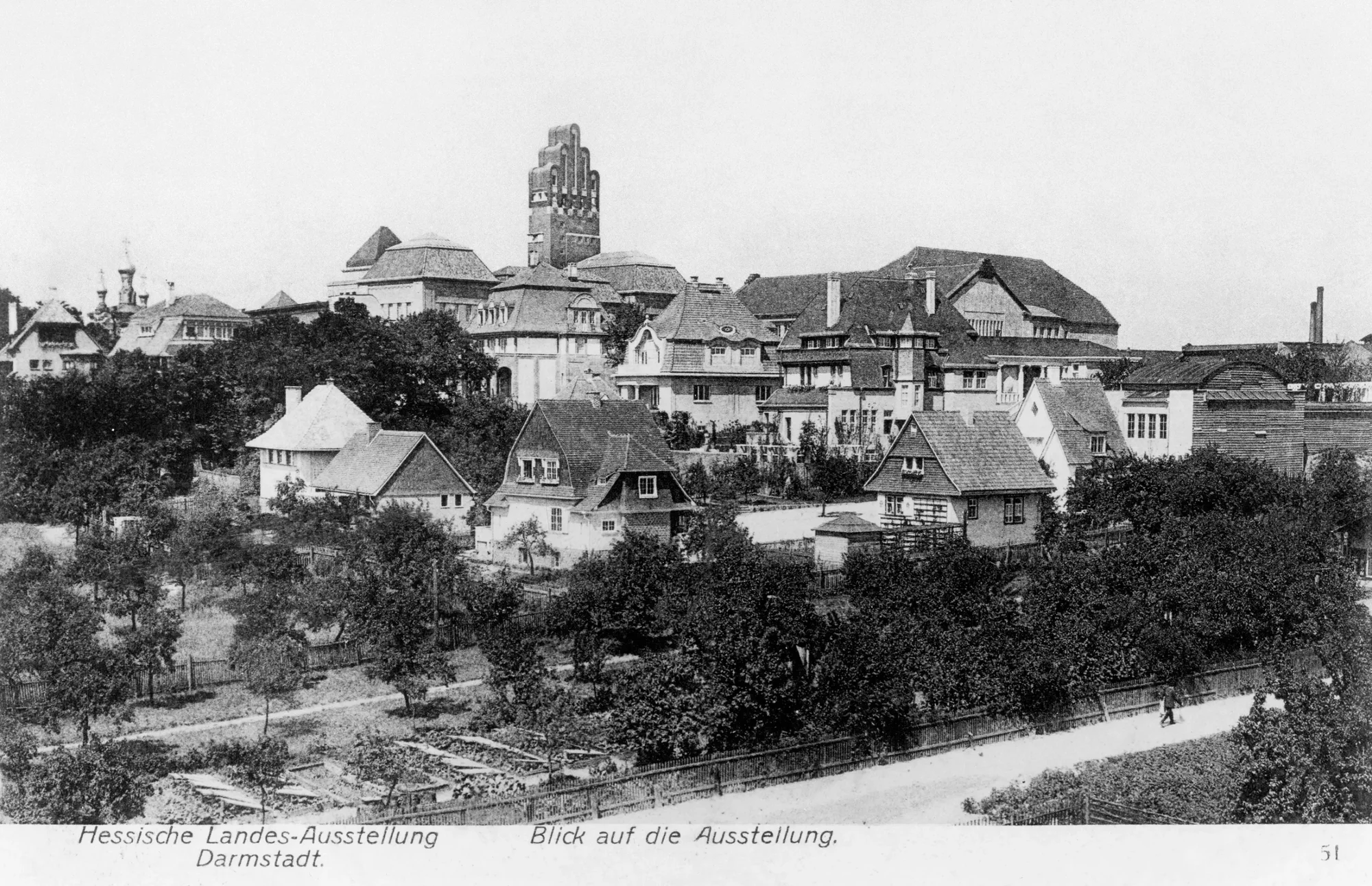
Nevertheless, the impact of the 1901 exhibition was enormous. It became the prototype for an international architectural exhibition that inspired numerous successors and continues to resonate today. The new suddenly appeared tangible: within two years, under Olbrich’s overall direction, a series of temporary buildings had been erected alongside the Ernst Ludwig House at the centre of the site and eight fully furnished houses forming the core of the ensemble. The painter Peter Behrens – who until then had only distinguished himself through graphic works and a few individual objects – independently designed and furnished his own house, inspired by symbols from Thus Spoke Zarathustra.
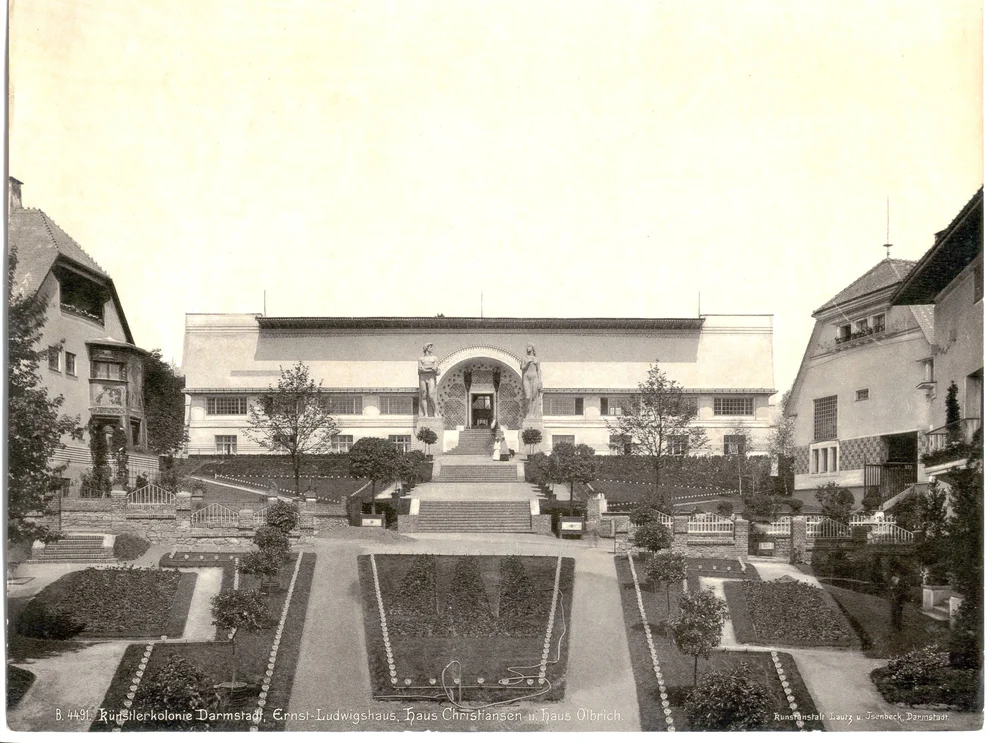
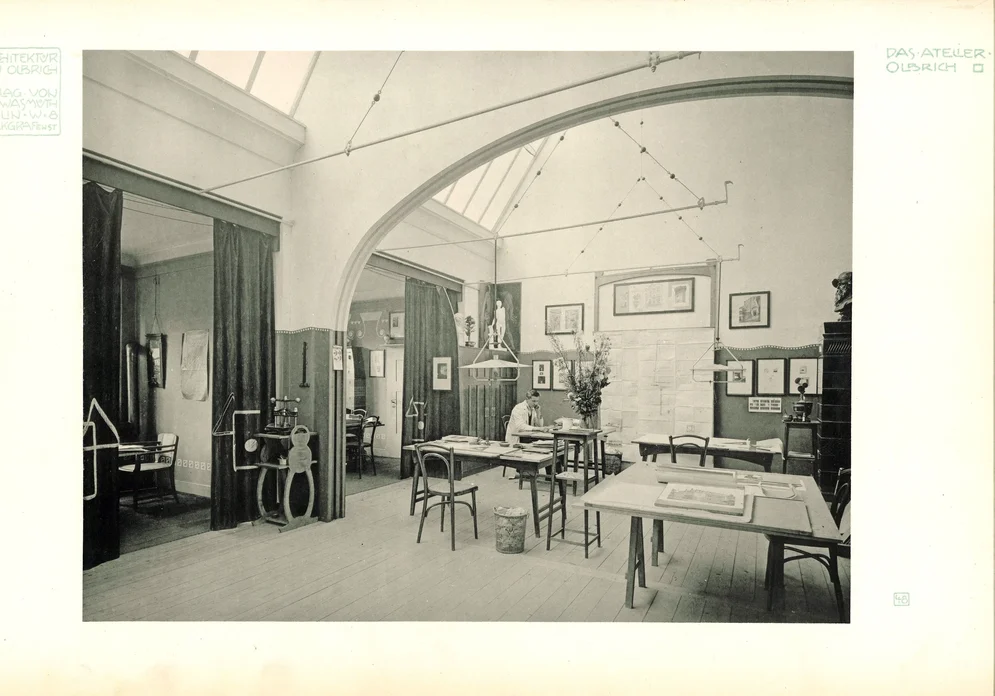
Three more modest exhibitions followed in 1904, 1908, and 1914, each addressing pressing contemporary issues – from workers’ housing to reform-oriented apartment construction. To mark the marriage of Grand Duke Ernst Ludwig and Eleonore Solms-Hohensolms-Lich, the citizens of the city donated the 48-metre-high Wedding Tower, in whose corner window bands Olbrich had already anticipated elements of later Bauhaus architecture by 1908. At the same time, the exhibition building was constructed atop the walls of the water reservoir. After Olbrich’s unexpected death in 1908, Albin Müller assumed artistic direction of the fourth and final exhibition in 1914. He designed the large reflecting pool beneath the Russian Chapel, while sculptor Bernhard Hoetger created the plane tree grove and the Lion Gate as the entrance ensemble. The ambition formulated on the Mathildenhöhe – to understand design as a social responsibility – continues to resonate to this day.

"Design always means taking responsibility"
Dr Philipp Gutbrod, Director of the Institut Mathildenhöhe Darmstadt, discusses in an interview the relevance today of the reform ideas from 1900, Mathildenhöhe as a place of new beginnings, and the social role of design in the modern world.