
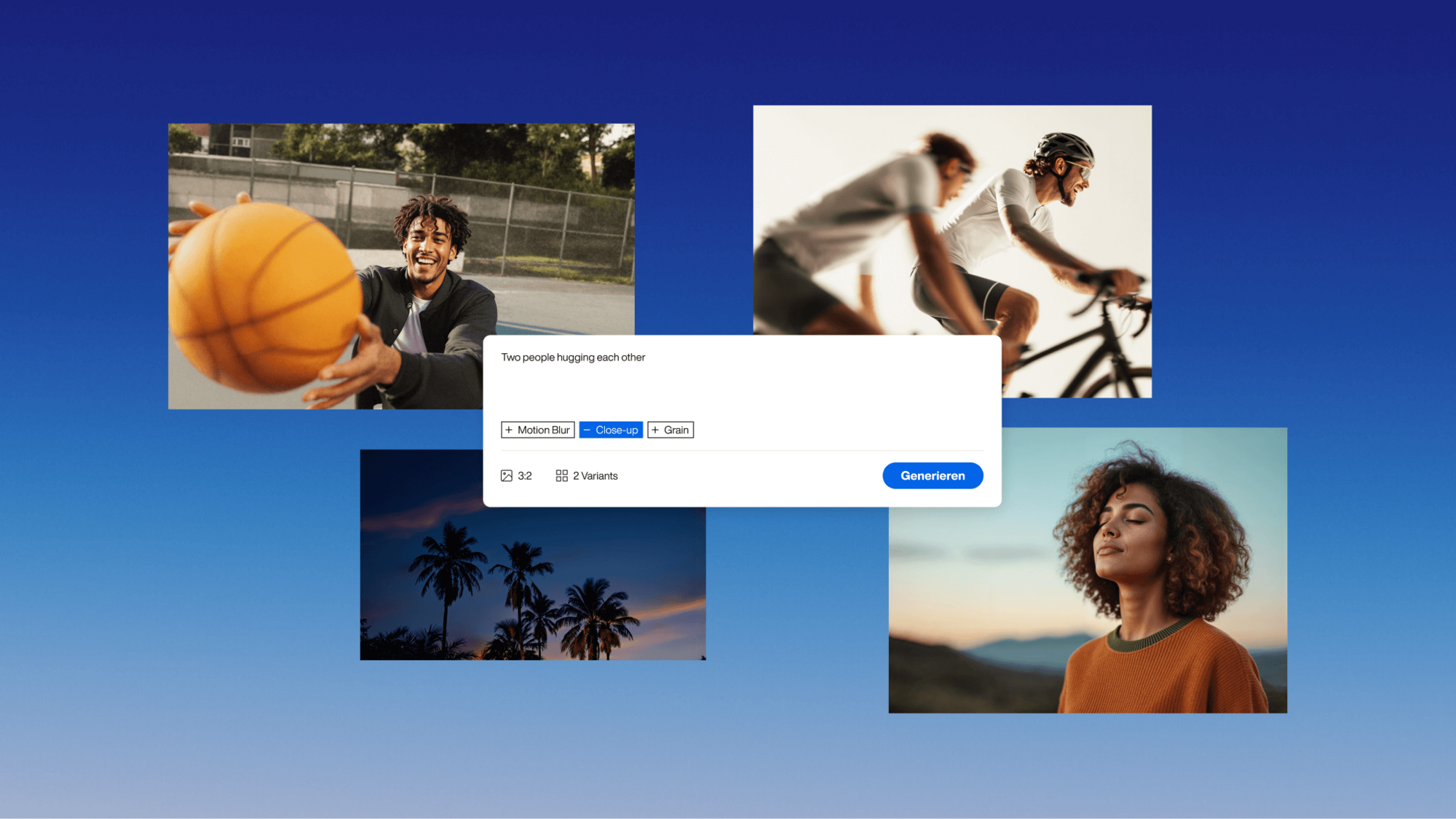
One-Click Creation
Thanks to artificial intelligence, Swedish start-up Lovable has become a unicorn in record time. Just two years after its launch, the company, which allows websites and apps to be created without any programming knowledge, achieved this feat. Its valuation now stands at more than US$1.8 billion. It's not just the start-up that has been successful though; its customers have been too. According to CEO Anton Osika, Brazilian entrepreneur Caio Moretti generated $3 million in sales in just 48 hours thanks to an app developed with Lovable. A success story that shows: Today, design is available at the touch of a button, with no need for any prior knowledge. Is this the democratisation of creativity, or the end of brand identity?
Without Context, It’s Just Average
Many other tools are also finding their way into branding and design. They simplify processes, speed up brainstorming, and enable content to be tested and adapted in record time. However, this comes with compromises and complex questions: how much can be automated without damaging the brand? How can authenticity be preserved when branding is taken over by algorithms?
Alex Jacobi, founder of the AI studio With Love and Data, has an answer: ‘Thanks to AI, brands can communicate authentically on a large scale for the first time.’ The tech platform combines marketing expertise with technology to help marketers and agencies work better and more efficiently with AI, making it accessible via an intuitive user interface.
However, this comes with one fundamental condition: the identity, tone, style and examples must be precisely defined within the AI tool itself. ‘Without context, the system adopts the opinion of the statistical average and appears interchangeable,’ Jacobi explains. Brands must have a clear understanding of their values, target groups and offerings, and implement a structured communication strategy.
Technology can provide agencies with effective support, particularly in the concept phase. ‘AI can be used in amazing ways in creative processes, such as creating mood boards and brainstorming ideas, as well as looking at thoughts from different angles. It also helps with branding, for example when researching or developing design and image worlds,’ says Katja Schnabel, Executive Creative Director at Zum goldenen Hirschen in Berlin. In addition, end results can be convincingly simulated, such as moving images, animations, music or speech. ‘AI greatly reduces the amount of preparatory work, which gives us more time to concentrate on the essentials.’ However: ‘When it comes to values and emotions – what really brings a brand to life – AI reaches its limits.’

Why People Remain Important
This means that people are needed here, with all their feelings, creativity, and ability to innovate. ‘AI is good at generating, evaluating and maintaining consistency, but only humans can make decisions, set goals and take responsibility,’ says Alex Jacobi. Building trust is also important: today more than ever, brands must succeed in doing so. Love brands are becoming trust brands. According to a study by Edelman, trust plays a role in the purchasing decisions of 80 per cent of consumers, with the majority (68 per cent) saying that it is important for the brand to authentically reflect today's culture. But can AI do that?
The Brand Science Institute at the University of Hamburg conducted a comprehensive study to analyse how the perception of brand identity differs between content developed by AI and content developed by copywriters. The study showed that content created by human copywriters produced a consistent and authentic perception of brand personality, which aligned with the original brand identity. AI-generated content, on the other hand, resulted in significant shifts, particularly with regard to emotional characteristics and tonality. High-priced brands, whose personalities typically encompass more subtle and complex characteristics, were particularly impacted. The authors of the study concluded that brand personality requires precise control and expertise. If AI is used, it must be closely monitored and supplemented with human sensitivity to create emotional depth. Using your own brand identity AI instead of generic AI tools based on standardised models helps with this. It can be tailored specifically to individual brand values, goals, and messages, thereby generating content that reflects the brand's actual identity.
Artificial Intelligence for Everyone
At wirDesign, the principle of ‘AI for everyone’ has been the norm for over a year. This technology is an integral part of all areas, including project management, creation, strategy and administration. The wirDesign.AI suite provides customers with their own tool for data-driven touchpoint analysis, consistent image generation and automatic layout validation.
‘Since 2024, our focus has consistently been on broad participation, continuous learning and genuine cultural change. We have also restructured our organisational form to enable us to act more quickly and shorten decision-making processes,’ explains wirDesign CEO Dirk Huesmann.
In 'BattlePrompt', the team learnt about prompting in a fun way. There is also a 'Daily ChatGPT Challenge', as well as training courses ('wirDesign Academy') and strategy days on the topic of AI. However, as Visual Design Director Lukas Linden emphasises, one key requirement always applies: 'Human-in-the-loop is crucial for us. AI provides options, but the creative and strategic framework remains with humans. This ensures that brand performance grows in the long term without losing authenticity.' Style guides and tonality are translated into tools, which keeps creativity free while ensuring consistency. However, AI requires the brand to be regularly reviewed and adjusted. 'It becomes a living system that needs to be refined again and again,' says Dirk Huesmann, CEO of wirDesign.
How the Role of Agencies Is Changing
The example of wirDesign clearly shows how the role of agencies is changing in the age of AI. ‘Agencies are becoming orchestrators,’ says Visual Design Director Lukas Linden: ‘They combine strategy, creation, data and technology to continuously improve the performance of their clients' brands. And our job is to develop frameworks, KPIs and workflows that fit the brand and ensure that tools are implemented and operated in a meaningful way.’
As the role of agencies changes, their organisational structure must adapt accordingly. AI is a powerful tool, but without a strategic framework, conceptual clarity, and human input, it remains just that – a technology. Dirk Huesmann sums it up succinctly: 'AI doesn't replace us; it makes us more effective.'