Make it Make Sense: Understanding the World Through Design
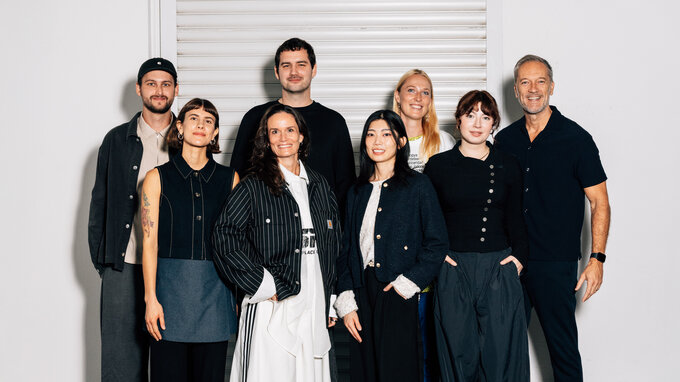
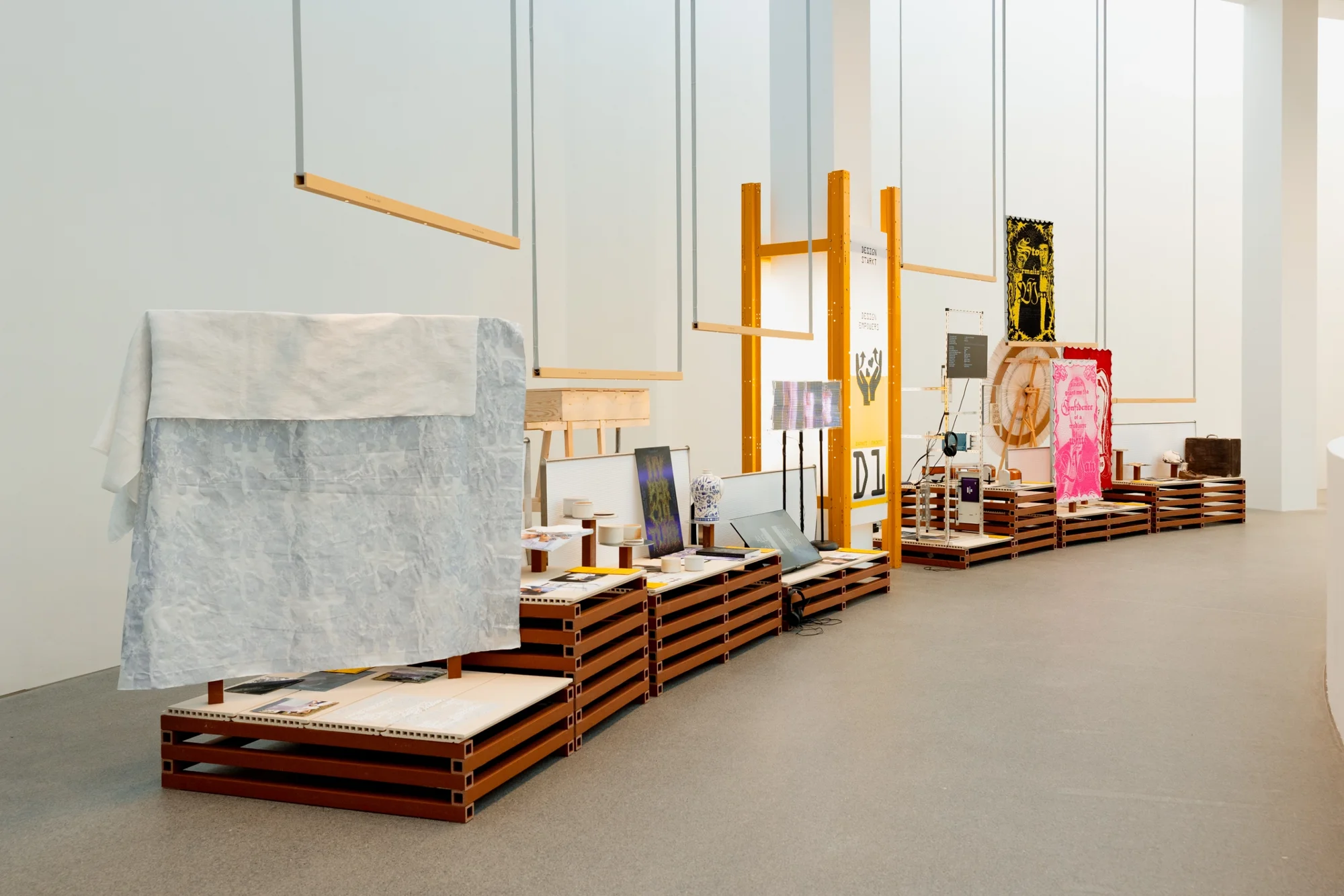
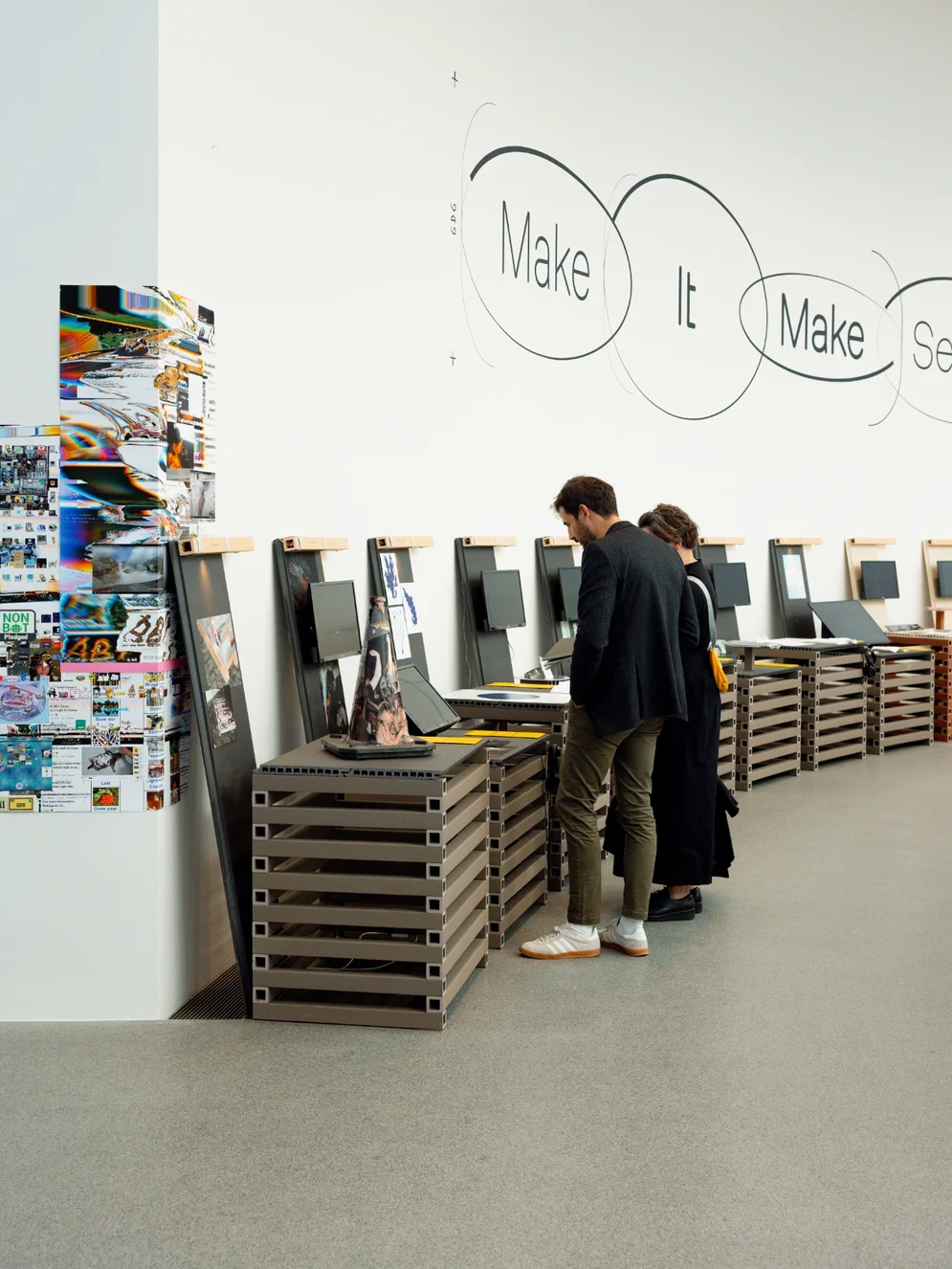
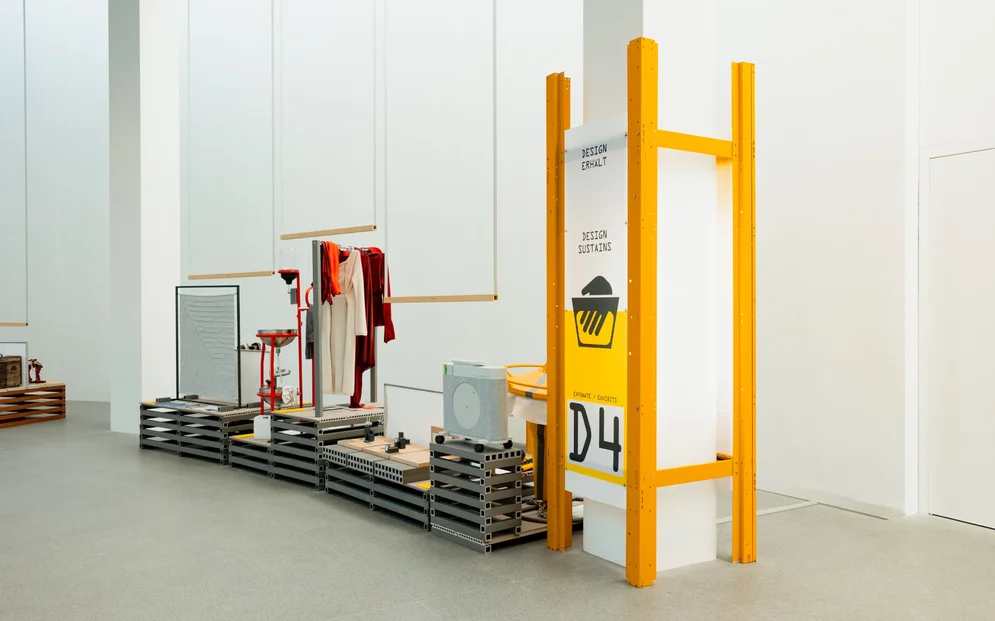
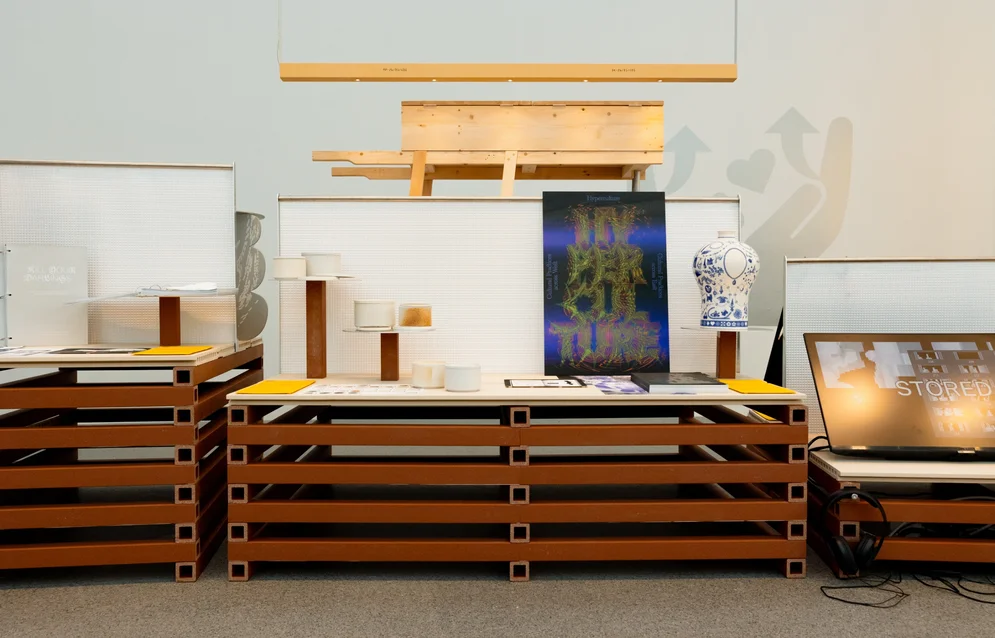
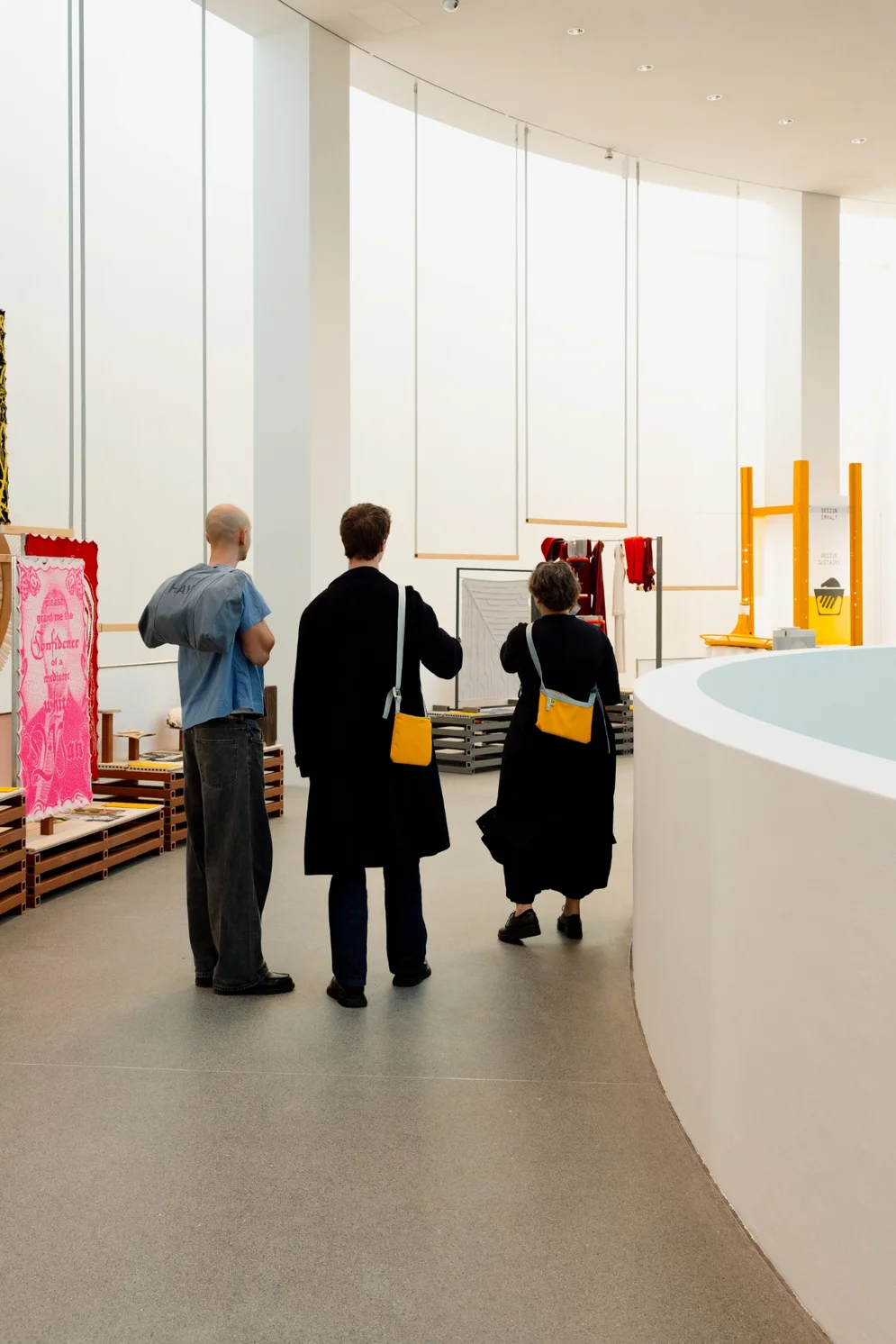
Anyone taking a reasonably close look around the Rotunda of the Pinakothek der Moderne, which offers a view of the museum complex from the top floor, will quickly realise that, quite literally, we have more knowledge at our feet than ever before. Yet while information is available and accessible at any time, the systems that organise our everyday lives are becoming increasingly opaque. Digital technologies may promise autonomy, but they also create new dependencies. And despite all the innovations and changes taking place, young people still have to navigate outdated and rigid social conventions that no longer seem compatible with many lived realities. “Make it Make Sense” – please, just make it make sense! The ironic expression, originating in meme and internet culture, gives the exhibition its title and can by now also be read as a serious demand. Alongside the diversity of disciplines represented, what is particularly striking is the decision not to organise the works according to traditional categories. Guided by the exhibition design by TTAL (Tobias Trübenbacher and Andreas Lang with Tillmann Gebauer) and the graphic design by Madruga Schreiber, social challenges become apparent: “Design Empowers”, “Design Experiments”, “Design Organises” and “Design Preserves”. Each points to the recurring question of what design can actually influence. Many of the works on display address subjects that might not immediately appear to fall within the remit of traditional design: shame, belonging, autonomy and the circular economy. More broadly, design becomes a method for examining contexts and making them visible.
Making the Personal Political
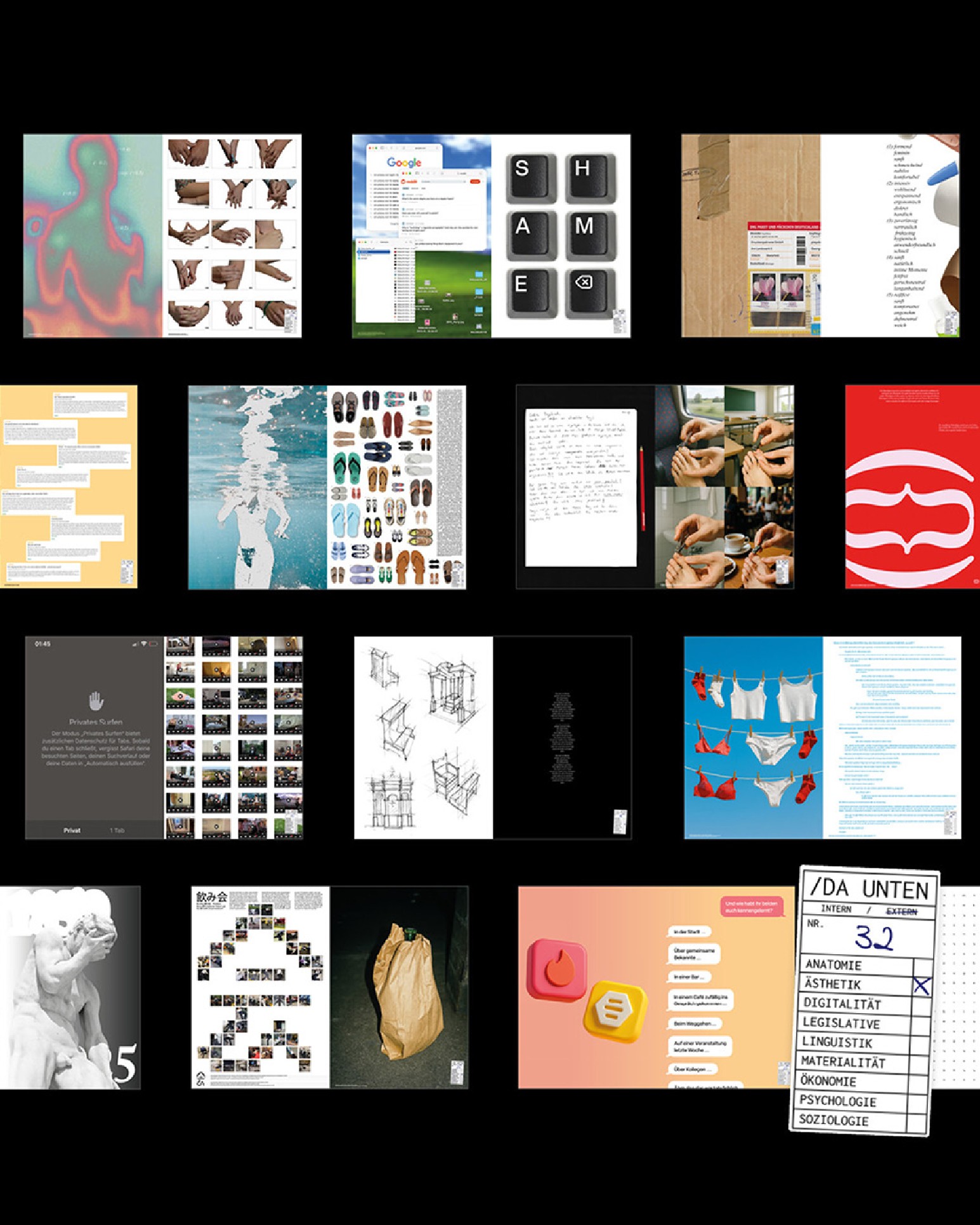
How deeply social norms shape our personal experiences is illustrated by Jette Bödige’s project “/DA UNTEN”. It begins with a feeling most people are familiar with but tend to deal with privately: shame. The graduate of DHBW Ravensburg has developed a large-scale research archive that examines this emotion not merely as an individual experience, but as something shaped by society that, in turn, shapes society itself. Her own research, alongside contributions from other designers, reveals how language, images, products, laws and body ideals influence what we feel ashamed of and which ideas about bodies, behaviour and belonging lie behind these feelings. This prompts an interesting shift in perspective: What takes place within an individual? And how can it be understood as something that has also been shaped beyond the self? Design creates a space in which this shift in perception can become a form of agency.
The project “Abenteuer-ABC” by Nina Maria Drangmeister from Trier University of Applied Sciences also explores questions of accessibility and social participation. Conceived as a multifunctional book project for primary school children, it combines the alphabet, experiences of nature and playful learning. Each letter becomes a removable leporello featuring activities, illustrations and short stories. While the concept itself is not entirely new, the accompanying sketchbook, which invites children to record their own observations and ideas, is particularly noteworthy in its simplicity. The design invites them to explore the world for themselves, cultivate curiosity, observe and experiment. As with other works in the exhibition, there is a sense that, for this emerging generation of designers, participation cannot be taken for granted. Whether we can see ourselves as active agents depends, in part, on which images and representations are available to us.
Looking Beyond the Product
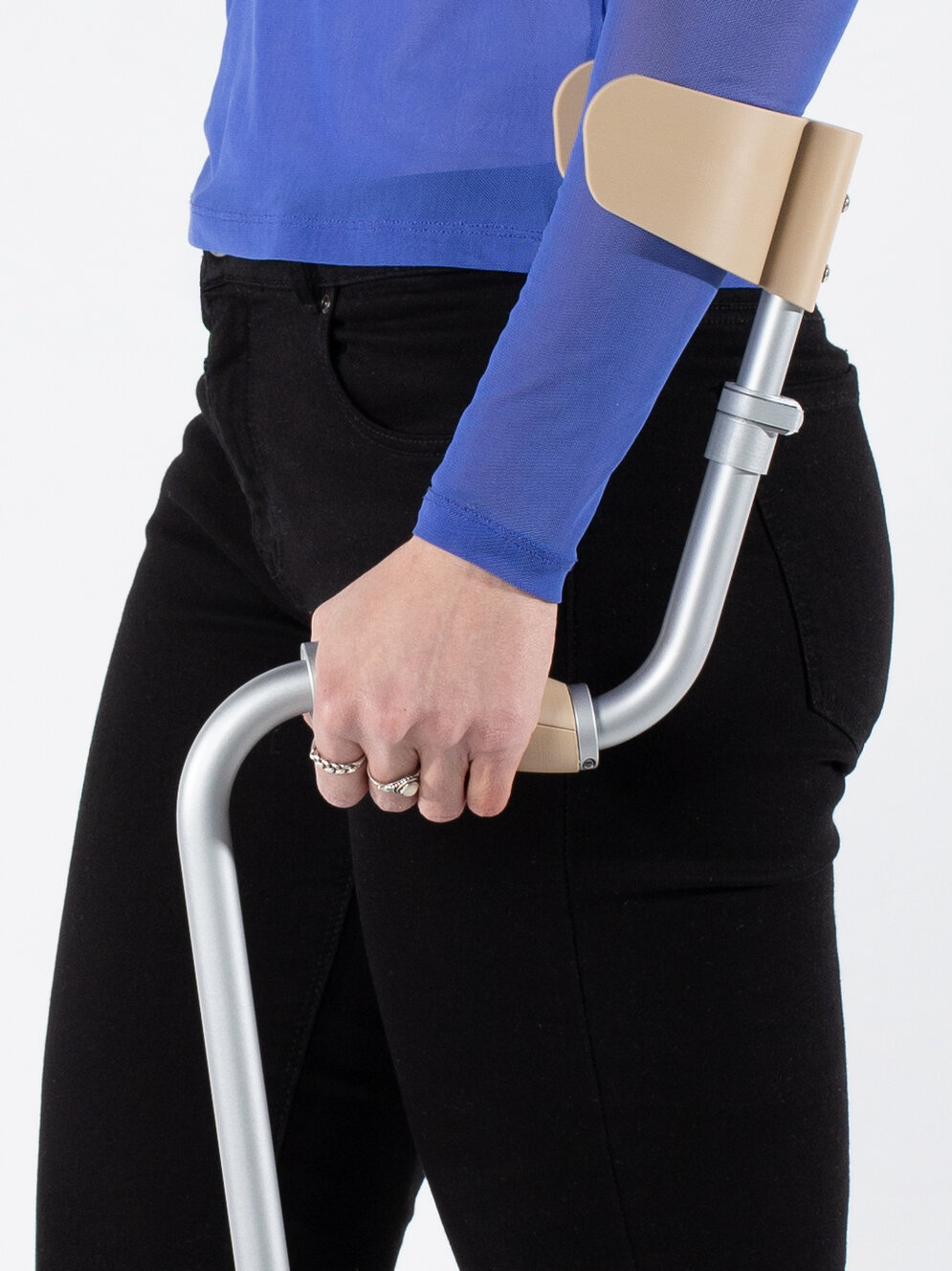
Design must also address situations in which an individual object forms part of a larger economic and ecological context. This is demonstrated by Sari Dahle’s project “Redesign for Circularity: Unterarmgehstütze cuRe”. The crutch is designed for multiple use cycles and combines a circular construction with a rental model. Plug-in and screw connections facilitate repair and disassembly, while a reduced range of materials supports recycling. Comfort and circularity are considered together.
The result is not a radically new object. In fact, the design achievement lies precisely in looking beyond the product itself and conducting thorough research. Forearm crutches are often only needed for a limited period of time. What happens to them afterwards? How can they be reused, repaired and reintegrated into a cycle of use? The project takes an everyday medical situation as its starting point to rethink the logic behind it, moving beyond aesthetics to incorporate use, maintenance and redistribution.

Of course, simple ideas can also be stylish. Mika Meinck’s project “Knoten” (Knot) from Düsseldorf University of Applied Sciences demonstrates how an ordinary object can carry a whole world of meaning. Through theory, experimentation and design, Meinck explores the principle of the reef knot, translating it into tangible objects: a modular jewellery collection made of 925 sterling silver and 3D-printed aluminium wall hooks. The components are interchangeable and compatible with one another. This makes the knot tangible on several levels: as a technical connection, a formal principle and a cultural symbol. Starting from a familiar form, Meinck develops a design exploration that does not separate function from aesthetics. Projects like this demonstrate how far emerging designers’ understanding of design has moved beyond the traditional notion of the finished product. Instead, it increasingly revolves around relationships: between objects and people, between material and function, and between individual use and wider social structures.
Grant Me Confidence
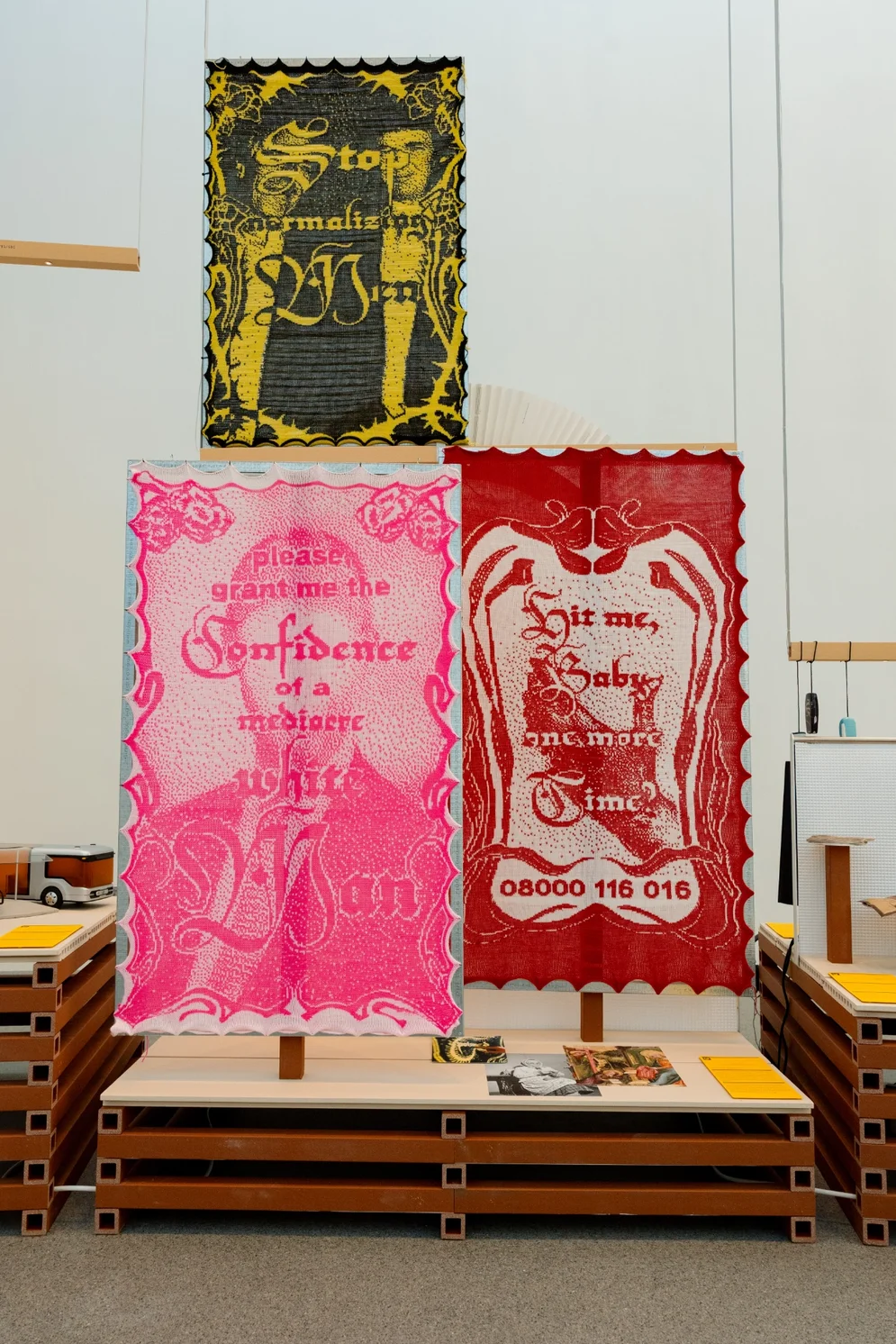
Und ja, dass gesellschaftliche Kritik nicht immer schwer und frontal daherkommen muss, beweist Joy-Fabienne Enzmann mit „Unravel“. Die Absolventin der Visuellen Kommunikation an der Bauhaus-Universität Weimar übersetzt die Ästhetik historischer Spruchtücher in großformatige Strickposter. Gefertigt werden sie mit einer Strickmaschine, die textile Technik wird dabei zum Träger einer Auseinandersetzung mit gesellschaftlicher Normierung, Protest und feministischer Selbstermächtigung. In der Schau zeigt sich dieser Habitus sehr auffällig in Gestalt eines pinkfarbenen Posters, das mit dem Satz „Please grant me the confidence of a mediocre white man“ eine ziemlich treffsichere Pointe setzt. Die Aufforderung spielt mit einer Beobachtung, die vielen Frauen vertraut sein dürfte: Wie viel Selbstbewusstsein Männern zugestanden wird, selbst wenn die tatsächliche Kompetenz überschaubar ist, und wie viel mehr andere leisten müssen, um überhaupt ernst genommen zu werden. Das traditionelle textile Medium und die gegenwärtige, bewusst zugespitzte Botschaft erzeugen dabei einen produktiven Widerspruch. Die Leichtigkeit, mal Ironie, ist eine Qualität, die der Ausstellung bei ihren vielen ernsten gesellschaftlichen Themen guttut: Als junger Mensch mit den Möglichkeiten von Gestaltung irritieren, Fragen stellen und Widersprüche offenlegen, ohne dabei den Zeigefinger zu heben, kann man sich Gehör verschaffen für komplexe Themen und so im Gedächtnis bleiben.
The selected works exemplify the different ways in which emerging designers approach their projects: through research, mediation, systems thinking, experimentation or with a healthy dose of humour. What they have in common is a willingness to examine the very conditions of their own design practice. Who benefits from a product? Which resources and histories remain invisible? How can design make an alternative perspective tangible? The works suggest that design education today must teach far more than a sense of form, knowledge of materials and technical skills. Critical thinking cannot be prompted. It requires the ability to conduct in-depth research, engage in discussions with fellow students about their understanding of society, and move between different fields of knowledge. The fact that the diversity of perspectives explored in “Make it Make Sense” is brought into view at a renowned institution such as the Pinakothek der Moderne should not be taken for granted. Nor should the openness with which these questions are left unresolved. This is precisely what makes the exhibition valuable: it shows that emerging design becomes particularly compelling when it refuses to settle for easy answers, uncovers connections, opens up alternative ways of seeing and makes things that once seemed immutable open to debate again. There is reason for optimism here. Fortunately, the next generation of designers does not have to make complete sense of the world before allowing itself to shape it – with curiosity, enthusiasm and the necessary seriousness.